


Wood Dossier: Taking Timber to New Heights — Literally
- Kim Cloutier

- Oct 22, 2025
- 6 min read
How Wood is Taking the Lead in Large-Scale Public Projects
Are you wondering whether wood can truly compete with concrete for municipal or multi-residential projects? Do you worry that choosing wood might compromise the building’s safety or durability?
Thanks to evolving codes and the emergence of high-performance engineered wood products, timber is no longer a niche solution.
In this article, discover why more and more municipalities, developers, and institutions are now choosing wood to build taller, faster — and greener.

A Material from the Past Making a Strong Comeback
In Quebec, wood has long shaped our cities. Up until the turn of the 20th century, it was omnipresent in residential neighborhoods as well as in public buildings. Light-frame structures, solid timber plank floors, cladding in clapboard or vertical boards — wood was everywhere, from structural frames to exterior finishes. But devastating fires — such as the 1845 blaze in Quebec City’s Saint-Roch district, which destroyed hundreds of buildings — changed this reality. For safety reasons, wood was gradually replaced by brick, concrete, and steel, materials considered more fire-resistant.
Today, the tide is turning. Thanks to advances in engineered wood, evolving building codes, and a drive to build more sustainably, Quebec is rediscovering this emblematic material with a new perspective: building with wood means combining modern performance with collective memory.
A Regulatory Framework Unlocking Wood’s Potential

For a long time, wood projects were restricted to single-family homes, mainly due to fire safety standards, perceived structural limitations, and a lack of recognition in building codes.
Today, everything has changed.
The 2015 National Building Code authorizes up to 6 stories in light-frame construction.
Quebec allows up to 12 stories in mass timber, subject to technical conditions.
The Policy on Wood Use in Construction (2021) aims to make wood a reference material in public projects. It encourages municipalities and institutions to prioritize wood through technical support, targeted funding, and oversight measures that ensure project quality.
And yet, in Quebec today, only 35% of new starts in the industrial, commercial, institutional, and multi-residential sectors use wood as a structural material. In reality, over 80% of non-residential buildings could be built in wood while still complying with current construction codes (Cecobois, 2024).
Today’s Wood: High-Tech and High-Performance
Unlike the wood used in buildings from the 1950s, today’s timber comes from advanced industrial processing methods, offering unmatched precision, strength, and stability. For example:

Cross-Laminated Timber (CLT):
Massive panels made of boards layered
perpendicularly, used as structural walls or slabs.

Laminated Veneer Lumber (LVL):
Engineered wood made of bonded veneer layers, used
in lintels, beams, and columns.

I-Joists:
Combine LVL flanges with an OSB web to create
lightweight yet very strong floor systems.

Glue-Laminated Timber (Glulam):
Laminated wood members bonded together, ideal for
long spans and large exposed structures.
These technologies make it possible not only to build taller, but also more sustainably, while meeting the strictest standards for fire safety, acoustics, and seismic performance. This “engineered” wood is also less sensitive to warping, moisture, and cracking, which extends the durability of structures.
The Advantages of Wood in Construction
Environmental Benefits

A Local, Renewable Resource
Wood comes from sustainably managed forests. Unlike concrete or steel, it grows, regenerates, and remains locally available.
An Active Carbon Sink
Each cubic meter of wood used in construction stores about one ton of CO₂, directly contributing to the fight against climate change.
Minimal Embodied Energy
Its processing requires little energy, and transport is often shorter and lighter compared to heavy or imported materials.
Less Pollution at Every Stage
Wood generates few greenhouse gases, and its impact on air, water, and soil is far lower than that of traditional materials.
A Favorable Life Cycle
Life-cycle analysis (LCA) of wood shows one of the lowest environmental footprints, from construction to end-of-life.
Compatible with Green Certifications
Wood makes it easier to achieve standards such as LEED or Passive House, thanks to its measurable sustainable performance.
Technical Advantages
Natural Thermal Comfort

With a thermal conductivity of about 0.09 W/m·°C, wood is 500 times more insulating than steel and 10 times more than concrete. It also acts as a thermal regulator, contributing to stable indoor temperatures.
Proven Strength and Safety
Engineered wood offers remarkable mechanical strength, both in compression and in tension, especially parallel to the grain. In the event of fire, it forms a char layer that slows combustion (~0.65 mm/min) and protects the internal structure. This behavior is recognized by building codes — even for high-rise buildings.
Reliability and Long-Term Stability
Factory-dried and calibrated, engineered wood demonstrates exceptional dimensional stability, limiting cracks, swelling, or warping.
Construction Advantages
A Lightweight, Easy-to-Handle Material
Wood is much lighter than concrete or steel, reducing foundation loads, simplifying transport, and speeding up work on site.

Prefabrication That Changes Everything
Factory-produced wood elements arrive ready to assemble. The result: shorter timelines, lower costs, greater precision, a cleaner site, and better quality control.
Compatibility with Hybrid Systems
Wood integrates seamlessly into mixed structures. Combined with concrete or steel, it makes it possible to leverage the advantages of each material.
Remarkable Architectural Flexibility
With wood, almost anything is possible: arches, curved forms, long spans, or fully customized structures. It adapts to bold and innovative architectural visions.
Tangible Savings, from Structure to Finish
Although slightly more expensive at purchase, wood often delivers overall savings thanks to faster installation, lighter structures that reduce foundation costs, its natural insulating power, and the ability to leave structures exposed, which lowers finishing costs. In light-frame construction, it is even the most economical option on the market.
Aesthetic and Cultural Advantages
A Naturally Soothing Ambience

Wood creates warm, human, and comforting spaces, far from the coldness of industrial materials.
A Living, Sensory Material
Its textures, reflections, scents, and colors evolve with light and time, creating a unique experience for users.
An Aesthetic that Showcases Structure
Whether as a finish or exposed structure, beams, columns, and paneling bring a distinctive and noble visual character.
A Strong Link to Quebec’s Identity
Choosing wood means valuing local resources, artisans, and regional expertise. It’s about making architecture part of culture.
Case Example: Fernand-Séguin School
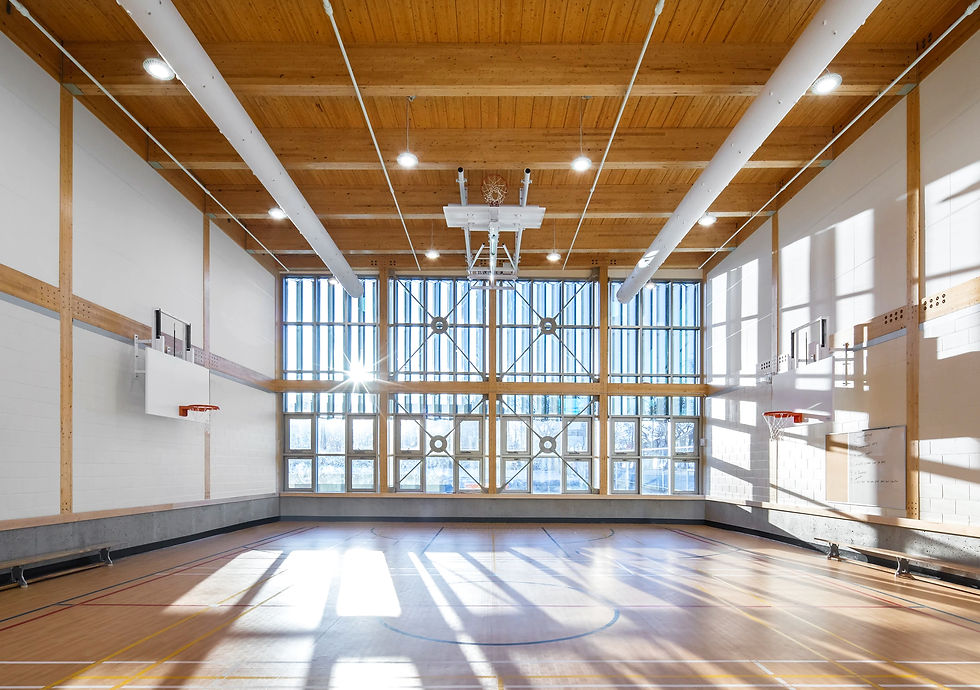
This project by the Montreal school service center, designed with a timber frame and interior CLT panel finishes, used the Gestimat tool to guide decision-making. The result? A 50% reduction in overall carbon footprint, without compromising acoustic performance or fire safety. Prefabrication also helped shorten construction timelines and minimize impacts on the neighborhood, while limiting disruptions to school activities and allowing students to move in more quickly.
The Gestimat Tool: A Simple Decision-Making Aid Available free of charge via this link, Gestimat allows users to compare the carbon footprint of different construction scenarios based on chosen dimensions and materials. Simply enter surface data and the type of structure to obtain clear, quantified results.


Inspiring Examples in Quebec and Beyond
La Pêche Town Hall
Quebec – BGLA Architecture
Exposed mass timber structure, a symbol of sustainability and local integration. (Passive House project)

Lab-École
Saguenay – BGLA Architecture + Appareil Architecture + Agence Spatiale
Designed to foster learning and well-being through warm, high-performance wood architecture.

Montreal FC Soccer Stadium
Montreal – Saucier+Perrotte + HCMA Architects
Large-span timber structure, showcasing the strength of the material for sports facilities.

Origine Project
Quebec – Yvan Blouin Architecte
A 12-story residential building with a hybrid timber-concrete structure, showcasing the potential of mass timber in urban multi-residential housing.

Brock Commons Tallwood House
Vancouver - Acton Ostry Architects + Hermann Kaufmann Architekten
An 18-story student residence, 17 of which are built in mass timber (CLT and glulam), that was the tallest timber structure in the world at the time of its inauguration. This pioneering project led to an evolution of the British Columbia building code, which now allows timber construction up to 12 stories.

Conclusion — Wood as a Strategic Lever: Are You Ready?
Wood is no longer confined to cottages or suburban homes. It is becoming a driver of innovation for cities, a decarbonization tool built on a local, accessible, and renewable resource. It has become a pillar of institutional and municipal architecture in Quebec and beyond. Why?
Because it performs.
Because it is sustainable.
Because it is Quebec’s own.
Now that you know what modern wood can achieve, why not consider this innovative material for your next community center, school, or multi-residential building?
Want to learn more?
To fully understand the use of wood in buildings over three stories — including codes, design, and municipal examples — consult the Guide on Municipal Wood Buildings by Cecobois (February 2019), a comprehensive and richly illustrated resource.
Whether you are at the early reflection stage or already well into a project, simple solutions exist to clarify your choices and measure the positive impacts of wood on your design process. Take the first step — and let this material of the future reveal its full potential in your project.


